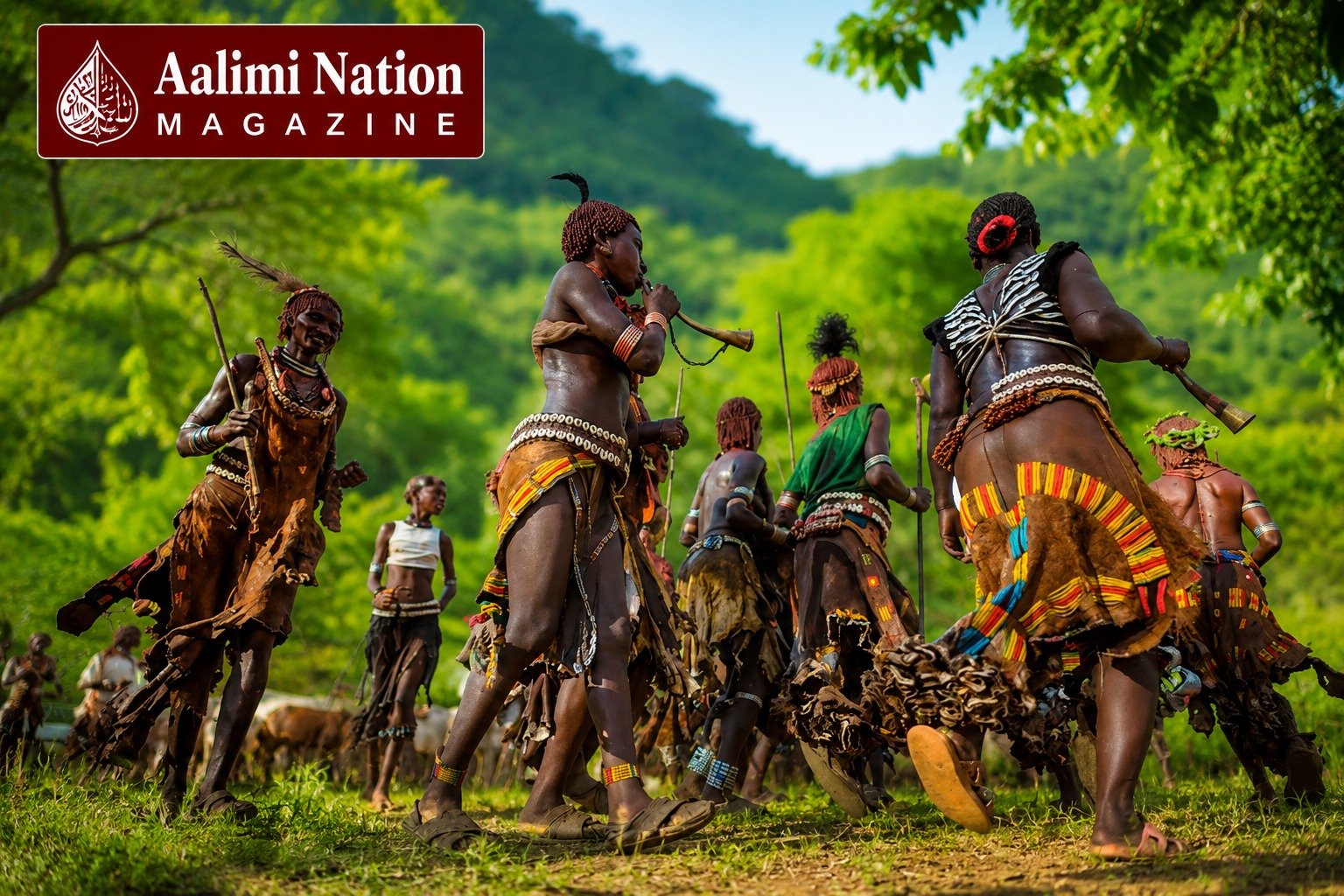
Ethiopia runs on a thirteen-month calendar, writes in an alphabet nobody else uses, and gave the world coffee. Behind those facts sits a word — yilugnta — that explains more about how Ethiopians treat one another than any of them.
Aalimi Nation · Culture Desk
Ask an Ethiopian what year it is and you may get an unexpected answer.
Ethiopia keeps the Ge'ez calendar, which runs roughly seven to eight years behind the Gregorian one and divides the year into thirteen months — twelve of thirty days each, and a thirteenth of five or six. The day begins at dawn rather than midnight, so what the rest of the world calls seven in the morning is one o'clock in Ethiopia. New Year falls in September, at the end of the rains, when the highlands turn yellow with meskel daisies.
This is not folklore preserved for tourists. It is the working calendar, used in banks, schools and government offices.
The reason it survived is the same reason a great deal else survived here. Ethiopia is one of only two African countries never fully colonised by a European power, and the only place on the continent where Christianity endured as a native faith rather than an imported one. The Ethiopian Orthodox Tewahedo Church traces its establishment to the fourth century, which makes it older than most of the churches of Europe.
What Ethiopia offers, then, is a rare thing: a large, ancient society whose cultural forms were never interrupted and rewritten by someone else.
Habesha
The word Ethiopians and Eritreans most often reach for to describe themselves is habesha.
Historically it referred to the Semitic-speaking peoples of northern Ethiopia and Eritrea — Amhara, Tigray, Tigrinya. Today it is used far more broadly, as a term for the shared cultural world of the region regardless of ethnicity or nationality, and it travels particularly well in the diaspora. In London, Washington and Dubai, Ethiopian and Eritrean communities separated by a bitter political history frequently converge under it.
That is worth pausing on. Two states that fought a war over their border, and spent two decades in a condition of frozen hostility, produced populations abroad who identify with one another through a cultural term that predates both governments.
Beneath habesha sits enormous variety. Ethiopia contains more than eighty ethnic groups and roughly the same number of living languages. The Oromo are the largest, followed by the Amhara, with Somali, Tigray and Sidama communities among the other major populations. Amharic holds official status nationally; Oromiffa, Somali, Afar and Tigrinya are official in the regions where their speakers form the majority. Most educated city dwellers move between three: Amharic, their own community's language, and English.
Yilugnta
If one word explains Ethiopian social behaviour to an outsider, it is yilugnta, and it has no clean English equivalent.
It describes a form of public self-consciousness — an awareness of how one's actions appear to others, and a resulting concern for their feelings. It is the impulse behind offering food you cannot spare to a guest who has arrived at an inconvenient hour, and the reason a stranger might quietly settle your bill without mentioning it.
Yilugnta produces the hospitality Ethiopia is known for, and it also produces restraint. Ethiopians are widely described as unconfrontational, patient, tolerant of inconvenience. Negative emotion is often held back rather than expressed, because expressing it might cause offence. There is a parallel cultural preference for stoicism: difficulties are downplayed, complaints are avoided, and problems are handled privately rather than laid on other people.
Readers in South Asia will recognise the shape of this immediately. The obligation to the guest, the reluctance to burden others, the sense that personal conduct reflects on family honour — these are familiar terms in Kashmir and across much of the subcontinent, even where the vocabulary differs entirely.
What Ethiopians add is the flip side of the same coin. Community support is real and substantial — neighbours, churches and mosques mobilise around families in crisis — but it is conditional. Generosity must be reciprocated. Those who do not extend it tend not to receive it.
They call this collective life mahiberawi nuro, and in a country where the state has rarely provided a reliable safety net, it functions as one.
The coffee ceremony
Coffee originates here. The plant grows wild in the forests of Kaffa, from which the word most likely descends, and the ritual built around it is the single best expression of the culture's sociability.
The ceremony takes upwards of an hour. Green beans are roasted over coals in the room, and the pan is carried around so guests can take in the smoke. The beans are ground by hand, brewed in a clay jebena, and poured from height into small handleless cups. Three rounds are served — abol, tona and baraka, the last meaning blessing — and leaving before the third is impolite.
Incense burns throughout. Popcorn is usually passed round. Nobody is in a hurry, because the point is not the coffee.
It is worth noting what this ritual assumes: that people have time for one another, that visitors will arrive without arrangement, and that an hour spent together requires no other justification. Many Ethiopians abroad report missing precisely this — the unstructured, unplanned sociability of home, where a social life could be maintained by sitting on a busy street and waiting to be spoken to.
Fasting, and a shared table
The Orthodox fasting calendar is among the most demanding in Christianity. Devout believers abstain from all animal products for well over two hundred days a year, including every Wednesday and Friday and the fifty-five days of the Great Lent.
The practical consequence is a national cuisine with an extraordinary vegan repertoire — lentil and split pea stews, collard greens, spiced vegetables — served on injera, the fermented teff flatbread that doubles as plate and utensil.
Meals are eaten from a shared platter, and there is a gesture called gursha: placing food into another person's mouth with your own hand, as a sign of affection and trust. Refusing one is a small unkindness.
Ethiopia is also, and equally, a Muslim country. Islam arrived during the Prophet Muhammad's lifetime, when a group of his followers were given refuge by the Christian king of Aksum — an episode remembered in Islamic tradition as the first hijra. Negash, in Tigray, is one of the oldest Muslim settlements anywhere, and Harar, with its dense warren of alleys and more than eighty mosques inside a walled old city, is a UNESCO World Heritage site.
The habesha world is not a Christian one with Muslims in it. It has been both for fourteen centuries.
Why it looks the way it does
Ethiopians are frequently frustrated by how their country is described abroad, and the frustration is reasonable.
For decades the international image was assembled almost entirely from famine and war — the crises of the 1980s, the border conflict with Eritrea, more recently the war in Tigray between 2020 and 2022 and the displacement that followed. Those events are real, and their consequences are still being worked through. But most Ethiopians regard them as a recent and terrible chapter in a very long book, rather than the book itself.
A country with its own alphabet, its own calendar, an unbroken religious tradition older than most of Europe's, and a coffee ritual it invented, does not think of itself as a humanitarian category. It thinks of itself as a civilisation that has had a difficult century.
That distinction is the beginning of understanding the place.