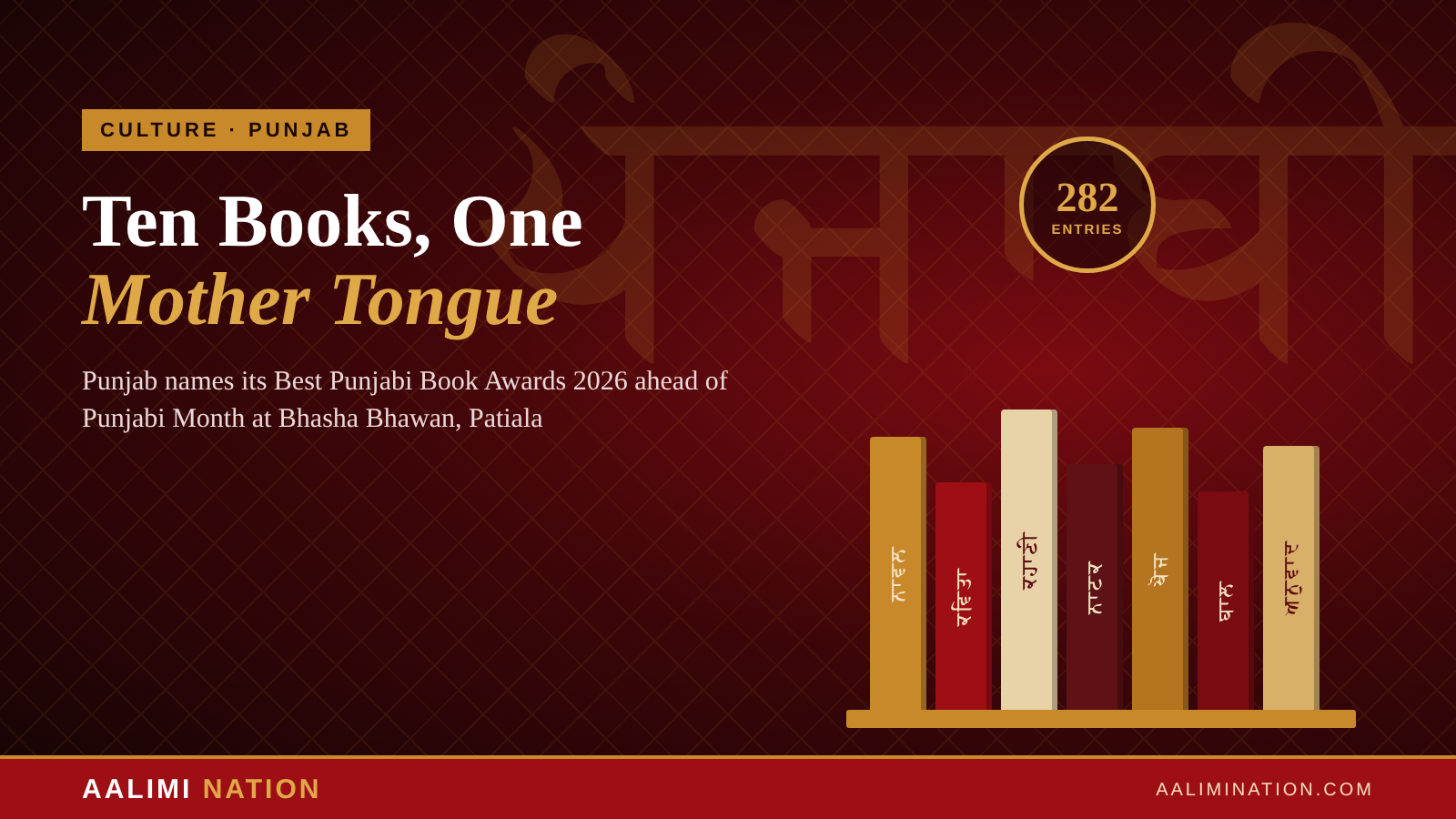
PATIALA — The literary year in Punjab has its winners. The state’s Language Department has announced its Best Punjabi Book Awards for 2026. Ten books, chosen from a field of 282, will be honoured in the first week of November. The ceremony is the state-level inauguration of Punjabi Month at Bhasha Bhawan in Patiala.
The awards are among the oldest forms of state patronage for Punjabi letters. Each winner receives ₹31,000, a citation and a plaque of honour. All entries were books published in 2025, and panels of subject experts from different fields evaluated them.
A shelf that spans the whole language
The list covers nearly every form of writing in Punjabi:
Novel (Nanak Singh Award): Jaspal Mankhera, Haveliala
Poetry (Giani Gurmukh Singh Musafir Award): Dr Navdeep Kaur, Ahilya
Short story (Prince Sujan Singh Award): Bhupinder Singh Mann, Lal Ratta
Biography and memoir (Bhai Vir Singh Award): Dr Ranjit Singh, Koi Nau Na Jaane Mera (Aap Beitian)
Essay, travelogue and satire (Gurbaksh Singh Preetlari Award): Ajay Tanvir, Jadunagari De Jadugar
Drama (Ishwar Chandra Nanda Award): Kulbir Malik, Dak Nit Aankhedi…
Translation (Prof. Gurdial Singh Award): Jang Bahadur Goyal, Jangal To Paar (Sita Ratnamal)
Knowledge literature and editing (M.S. Randhawa Award): Principal Lovely S. Pannu, Puadhi Lok-Kavi (Tappe Aar Jakkariyaan)
Children’s literature (Sri Guru Harkrishan Award): Hari Krishna Mair, Plastic Da Daddu
Criticism and research (Dr Atar Singh Award): Dr Dharam Singh, Pragat Bhaye Gur Tegh Bahadur
The award names are a roll call of Punjabi literature’s founders. Nanak Singh is widely regarded as the father of the Punjabi novel. Bhai Vir Singh was a central figure of modern Punjabi poetry and prose. Gurbaksh Singh Preetlari’s Preet Lari magazine shaped generations of readers. Honouring new writers in their names links this year’s books to more than a century of tradition.
Regional voices, sacred history and a child’s plastic toy
Several winners point to where Punjabi writing is heading.
Pannu’s prize goes to a collection of tappe and jakkariyaan. These are folk verse forms from Puadh, the dialect belt along the Ghaggar that is often overshadowed by Majhi and Malwai Punjabi. Recognising this work signals that the department values documenting the language’s lesser-heard voices, not only its literary standard.
Dr Dharam Singh’s research prize is timely. His book on Guru Tegh Bahadur arrives as Sikh institutions continue to mark the legacy of the ninth Guru, whose 350th martyrdom anniversary fell in late 2025.
Mair’s Plastic Da Daddu won the children’s category. Punjabi teachers have long said a language survives only if children read it for pleasure, not just for exams.
The voice behind the announcement
Jaswant Singh Zafar, Director of the Language Department, announced the results. He congratulated the winners and urged writers and readers to keep working to promote Punjabi. He also said the department’s book awards for other languages would be presented during the Punjabi Month celebrations.
Zafar, a noted poet himself, has spoken publicly about the pressures facing the language. At last year’s Amritsar Sahit Utsav he warned that relying solely on machine intelligence would “creatively bankrupt us.” He also said serious researchers of Punjabi should know both Gurmukhi and Shahmukhi. Shahmukhi is the Perso-Arabic script used across the border in Pakistani Punjab.
Hindi and Urdu honoured too
On October 9 the department announced its Best Hindi and Urdu Book Awards for 2026: seven titles, each carrying the same ₹31,000 prize. These will be presented at the closing ceremony of Punjabi Month in November.
In Urdu:
Hafiz Mehmood Shirani Award (Criticism): Dr Salik Jamil Brar, Urdu Mein Adab-e-Atlaaf Ka Manzar-Pashe Manzar
Sahir Ludhianvi Poetry Award: Harbhajan Singh Taswar, Man Kistam Man Neestam
Kanhaiya Lal Award (Prose): Malkit Singh Machhana, Chutkiyaan
In Hindi:
Sudarshan Award (Novel/Story): Suresh Hans, Kasturi Kundal
Indranath Madan Award (Criticism): Dr Rakesh Prem, Kathashilpi Premchand
Baba Fateh Singh Award (Children’s Literature): Dr Poonam Gupta, Nanhe Kadam Badi Baate
Mohan Rakesh Award (Drama): Prof. Kashmir Luna, Janak
Sikh, Hindu and Muslim names appear together on the same Urdu list. The Urdu poetry prize is named after Sahir Ludhianvi, the son of Ludhiana who became one of Urdu’s best-loved lyricists. Together these details show that Punjab’s literary inheritance has always been plural. The department says its Sanskrit awards will be announced soon.
Why it matters
Punjabi has an estimated global speaking population well over 100 million, but writers in the language are uneasy. At festivals and book fairs, older writers worry that the young treat folk culture as a curiosity. Lyricists, meanwhile, have argued that market pressure is thinning the literary depth of Punjabi song. A state prize cannot solve these problems alone. It does, however, put serious books, many from small presses, in front of readers who might otherwise never find them.
The awards will be presented at Bhasha Bhawan when Punjabi Month opens in early November. There, Punjab’s language will celebrate the people still writing it.
— Aalimi Nation Culture Desk