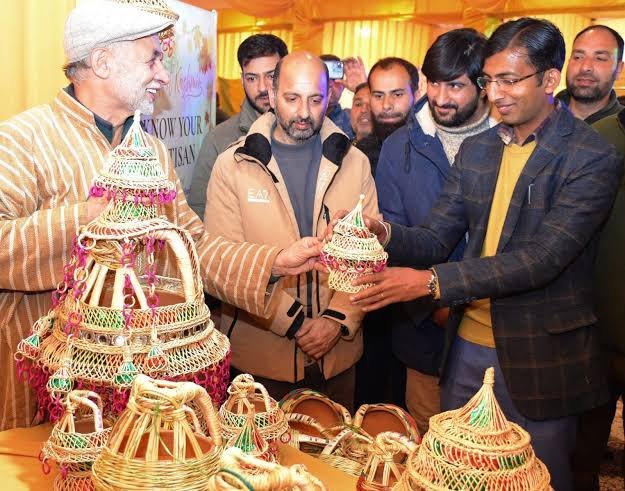
SRINAGAR, October 20 (Aalimi Nation) – A two-week festival in Srinagar is bringing weavers, artists and musicians together to revisit Kashmir craft heritage. KaniFest 2026 opened on Saturday, October 17, at KaniHome in Zakura and runs until October 30.
The festival celebrates the Valley's cultural heritage, craftsmanship and contemporary art, and seeks to connect traditional practice with newer creative forms, according to a report in Greater Kashmir. Artisans, designers, researchers, educators, filmmakers, students and entrepreneurs have been invited to take part.
What the festival offers
The programme mixes discussions, workshops, live performances and hands-on sessions built around culture, nature, technology and the arts. Evening music sets feature Gaekhir Republik, Moze and Ali Saifuddin, while creative technologists based at KaniHome are presenting projection-mapping work.
The stated aim is collaboration and skill exchange across disciplines, giving craftspeople and younger practitioners a common space to experiment. KaniHome describes itself on its website as a creative residency for artists, artisans and cultural enthusiasts.
Kashmir craft heritage and the artisan economy
The festival's name recalls the Kani shawl, one of the Valley's best-known textiles. In Kashmiri, a kani is the small wooden spool weavers use to work intricate patterns into pashmina yarn, a technique closely associated with Kanihama village in Budgam district. The Kani shawl carries a Geographical Indication (GI) tag.
The event follows renewed official attention to handicrafts. At the Pashmina Artisan Awards 2026 in Srinagar on September 30, Lieutenant Governor Manoj Sinha said the handloom and handicrafts sector supports about 4.6 lakh artisans and their families in Jammu and Kashmir. He said 18 crafts in the Union Territory hold GI tags and that a QR-based system has been developed to help establish whether products are authentic.
Sinha devoted much of his address to women, who work at almost every stage of pashmina production.
"Women artisans are not merely participants in this tradition, but they are its silent creators, its custodians and its heartbeat," Lieutenant Governor Manoj Sinha said in Srinagar on September 30.
Speaking directly to the artisans, he said: "You should never feel that your work is ordinary," Kashmir Observer reported.
The awards were organised by the Pashmeena Entrepreneurs Makers and Artisans (PEMA) Foundation, whose president is Tariq Dar. Sinha said the UT administration and the foundation would work together on the sector, listing priorities that include fair pay, protection of GI tags, access to global markets, skills training and financial inclusion.
Pressures on traditional crafts
The renewed interest comes amid concern about the future of hand-made textiles. In an opinion piece published in Kashmir Vision on October 3, writer Mohammad Hanief argued that shawl-making faces changing markets, mechanisation, imitation products and falling participation by artisans, with younger people put off by uncertain returns.
Hanief also wrote that machine-made imitations can be hard for buyers to tell apart from hand-woven shawls. The administration's GI tags and QR-based checks are intended to help establish that a product is genuine.
What comes next
KaniFest continues at Zakura until October 30 with further workshops, talks and evening performances. Officials have not yet announced a timeline for the joint initiatives with the PEMA Foundation that Sinha outlined last month.