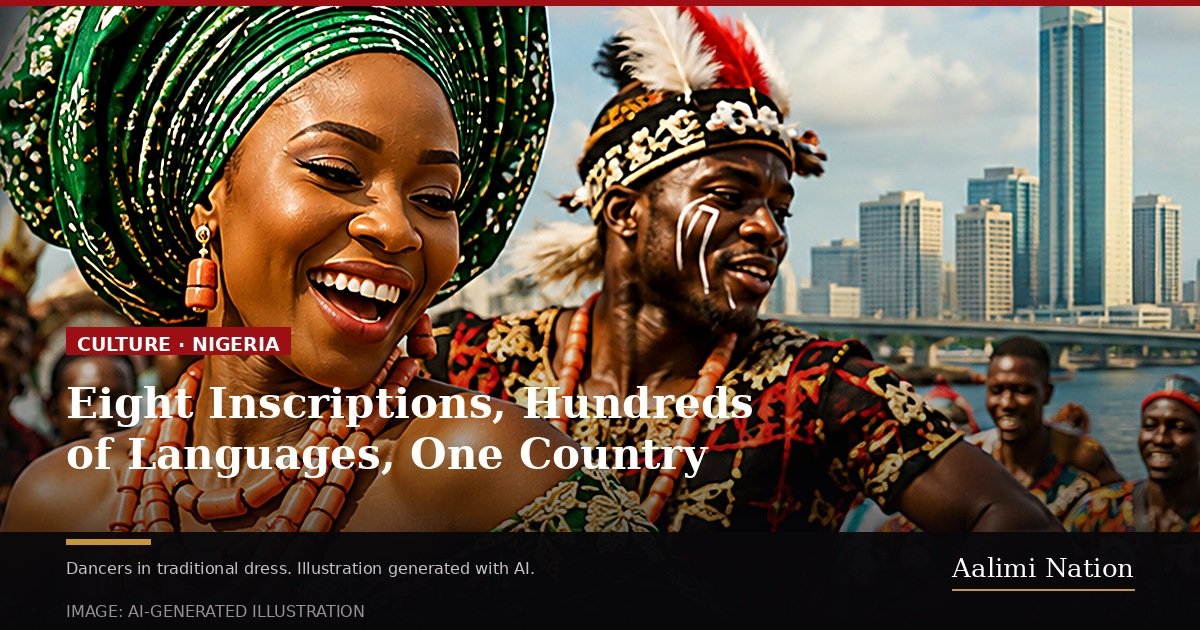
Nigeria has more people than Russia and more languages than the whole of Europe. Its culture is not a single tradition but a working negotiation between several — and it has become the continent's most successful export.
Aalimi Nation · Culture Desk | Lagos
There is no such thing as Nigerian culture in the singular, and Nigerians will tell you so first.

A country of more than 200 million people contains the Hausa-Fulani of the north, the Yoruba of the southwest, the Igbo of the southeast, and the Edo, Ijaw, Efik, Ibibio, Tiv and hundreds of smaller communities besides — speaking somewhere above 500 languages between them. What holds as a national culture is not one inherited tradition but the constant traffic between many.
That plurality is now formally recognised. Nigeria has eight elements inscribed on UNESCO's Representative List of the Intangible Cultural Heritage of Humanity, and the register reads as a map of the country's regions.
What UNESCO has recognised, and when
The list began in 2008 with two Yoruba entries: the Ifá divination system, the elaborate corpus of verses and interpretation used by babalawo priests, and the oral heritage of Gelede, the masked performance tradition honouring the primacy of women.
The Ijele masquerade followed in 2009 — the towering Igbo masquerade of Anambra State, also performed in Enugu, Imo and Ebonyi, and regarded as the largest masquerade in sub-Saharan Africa.
In 2016 came the Argungu international fishing and cultural festival in Kebbi State, where thousands of men enter the river together at a signal, armed with hand nets. In 2019, the Kwagh-hir theatrical performance of the Tiv people of Benue — a form combining puppetry, masquerade, song and storytelling.
The 18th session of the intergovernmental committee, held in Kasane, Botswana, in December 2023, added the Sango Festival of Oyo, honouring the deified third Alaafin of the old Oyo Empire and held each August to usher in the Yoruba new year, alongside a multinational inscription on midwifery knowledge, skills and practices shared with eight other countries.
The most recent came in December 2024, at the 19th session in Asunción, Paraguay: Durbar in Kano, the equestrian procession held at Eid al-Fitr and Eid al-Adha, in which noblemen pay homage to the Emir on horseback. It is believed to be the largest procession of decorated horses in the world.
Receiving the certificate in Abuja, the Minister of Art, Culture, Tourism and the Creative Economy, Hannatu Musawa, made the government's calculation explicit. "What really makes Nigeria great is our cultural expression. Our diverse cultures represent every part of the world," she said, adding that the ministry intended to "export our culture and creativity to bring people to Nigeria" and thereby contribute to economic expansion and job creation.
Nigeria's permanent delegate to UNESCO, Hajo Sani, framed inscription as an obligation rather than a trophy, saying it "calls for greater responsibilities of government and all stakeholders to maintain the Durbar festival and keep it sustainable within the scope of its new international status."
Two more nominations are pending: the Amaseikumor Festival and the Ikeji Masquerade Festival.
The calendar
Beyond the UNESCO list sit festivals that structure the year across the country.
The Osun-Osogbo Festival in Osun State draws worshippers and visitors to the sacred grove of the river goddess Osun each August — the grove itself was inscribed as a UNESCO World Heritage Site in 2005, a separate designation covering places rather than practices, and one of the last intact sacred forests in Yorubaland.
The New Yam Festival, Iri Ji, marks the start of the Igbo harvest, when the first yams may be eaten only after they have been offered to ancestors and the gods. The Eyo Festival fills Lagos Island with masquerades in white robes and broad hats, moving in silence through streets closed to traffic. The Ojude Oba in Ijebu-Ode, held two days after Eid al-Adha, has become the most photographed event in Nigerian fashion, with age-grade groups and horsemen competing in dress before the Awujale.
Note what that calendar contains: Yoruba deities, Igbo harvest rites, Islamic festivals and Christian observance, running through the same year in the same country.
The clothes
Nigerian dress is among the most visually distinctive in the world, and it carries information.
The agbada, the wide-sleeved flowing robe, signals status and formality across Yoruba and northern traditions. Aso-oke is the hand-woven Yoruba cloth reserved for ceremony, its narrow strips sewn together. Ankara, the printed wax cotton, is everyday wear and high fashion at once. The gele, the woman's headwrap, is tied into architecture — its height, angle and fold are read by everyone present.
Coral beads mark chieftaincy. Embroidery marks region. What outsiders see as pattern, Nigerians read as a sentence.
Contemporary designers have taken these forms into international fashion without abandoning them, which is why Nigerian tailoring now appears on runways in London and Paris rather than only in museums.
Nigeria's largest cultural influence is not in a heritage register. It is on a phone.
Afrobeats descended from but distinct from Fela Kuti's political Afrobeat of the 1970s — has become one of the defining pop sounds of the last decade, filling arenas in London, New York and Delhi and shaping production styles far beyond Africa. Nollywood, producing more films by volume than almost any industry on earth, carries Nigerian languages, family structures and social arguments to audiences across the continent and the diaspora.
Neither was built by the state. Both were built by young people with limited capital and no institutional support, and both now function as soft power the government is keen to claim. The creative economy has become a stated instrument of national development policy, which is a reversal of the usual order: culture succeeded first, and policy followed it.
Nigerian food travels on the same route.
Jollof rice the subject of an affectionate and genuinely unresolved rivalry with Ghana sits alongside suya, the spiced skewered beef of northern street corners, egusi soup thickened with melon seed, pounded yam and amala, moi moi steamed from bean paste, and pepper soup taken hot enough to clear the head.
Food is increasingly deployed as diplomacy. Abuja hosted the 2026 China-Nigeria Food Festival this week, combining cuisine, music and cultural performance — an event that says as much about where Nigeria places its cultural bets as any ministry statement.
The interesting thing about Nigerian culture is not its variety, which many large countries have. It is that the variety is worn simultaneously rather than sequentially.
A young Nigerian may attend a family ceremony in aso-oke, observe a religious festival that predates or postdates the other by centuries, listen to Afrobeats produced in a Lagos bedroom, watch a Nollywood film about the tensions between those very worlds, and consider none of it contradictory.
For readers in Kashmir, the pattern will not feel foreign. Plural societies with deep and sometimes competing traditions face the same question — whether difference is a fracture or a resource. Nigeria's answer, at least in its culture, has been to treat it as material.
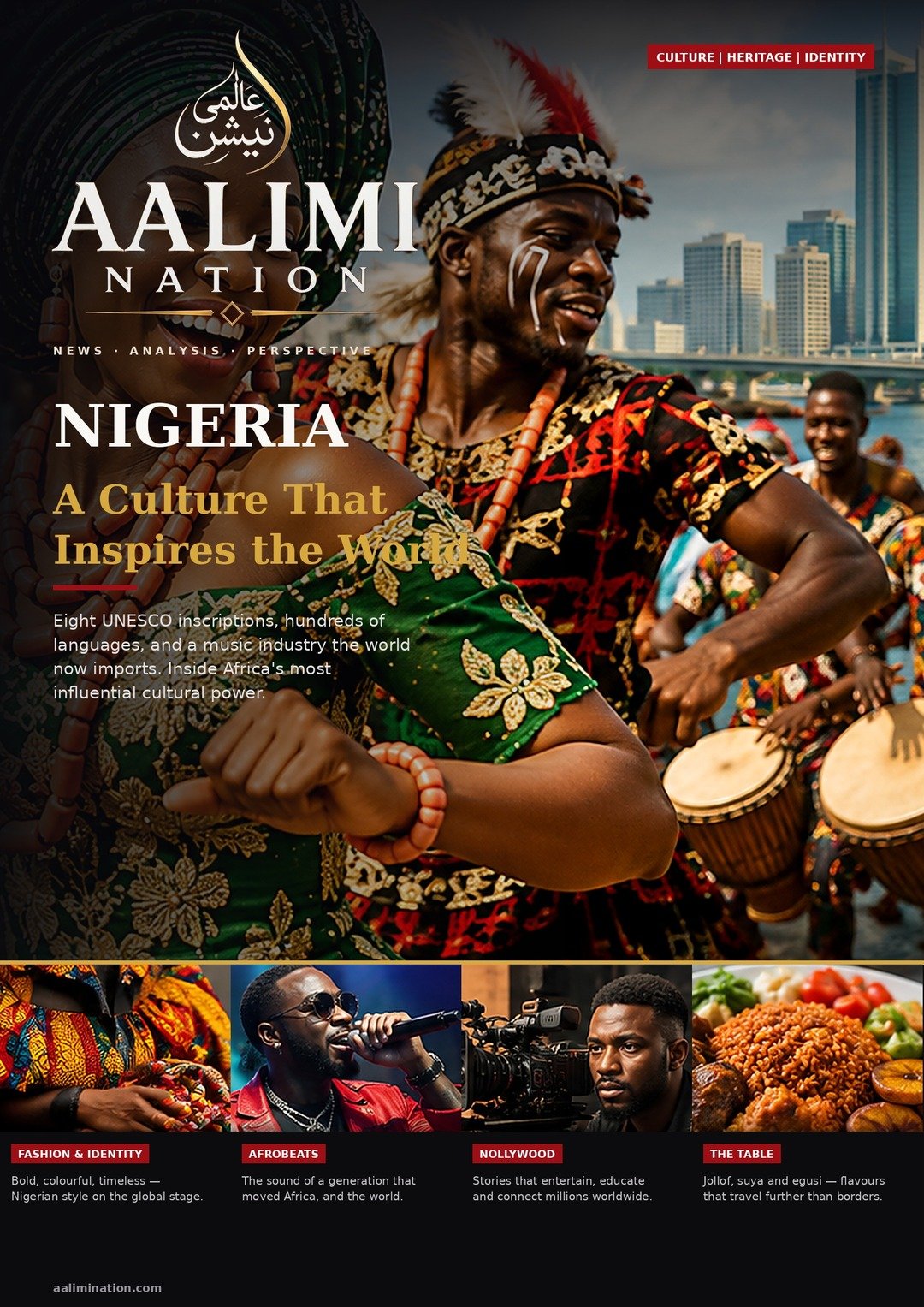
Eight inscriptions, five hundred languages, and a music industry the world now imports. That is not a country with a culture. It is a country with several, and the confidence to sell them.