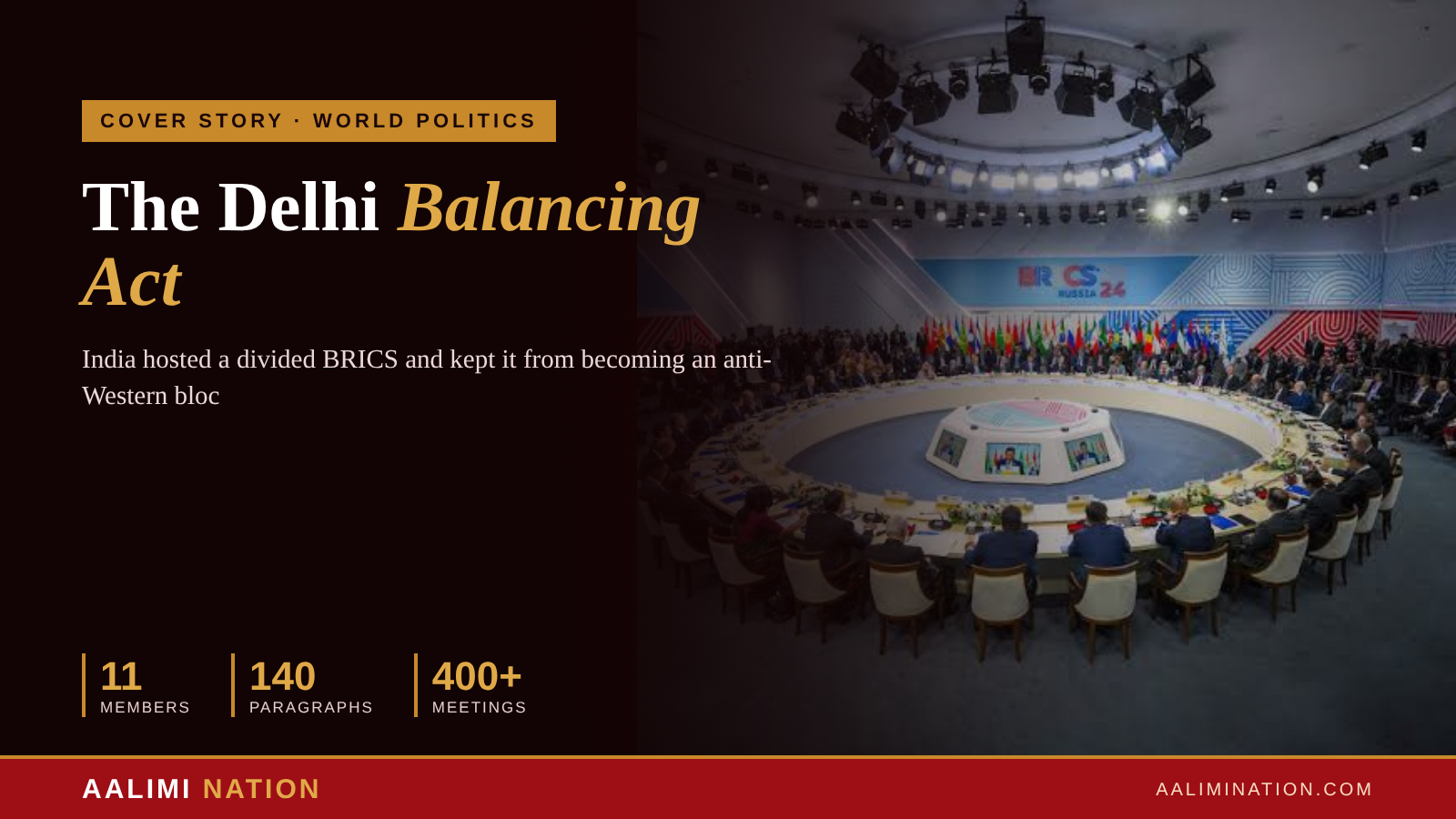
The 18th BRICS summit brought Xi Jinping to India for the first time in seven years and seated Iran's president a few chairs from the Gulf states his country has attacked. India's aim was to keep the bloc from turning against the West.
NEW DELHI — The leaders who gathered at Bharat Mandapam in mid-September met at an awkward moment. Since late February, the United States and Israel have fought a war against Iran, and Iran is a full member of BRICS. So is the United Arab Emirates, whose territory Iranian missiles and drones have targeted. Russia is still at war in Ukraine. Washington, meanwhile, has used tariffs against many of the bloc's members.
It was India's task, as chair, to bring these governments together and produce a joint statement. Reuters had described reaching consensus as a particularly difficult task for the host. A BRICS foreign ministers' meeting in May had already collapsed without a joint communiqué, leaving India to issue a chair's statement instead.
Remarkably, New Delhi succeeded. On September 12, the summit unanimously adopted a 140-paragraph New Delhi Declaration. It was the product of more than 400 meetings held in 30 Indian cities during India's year as chair.
A bloc of contradictions
BRICS began in 2009 as an economic grouping of Brazil, Russia, India and China; South Africa joined the following year. It has grown quickly since. Official lists now count eleven members: Brazil, China, Egypt, Ethiopia, India, Indonesia, Iran, Russia, South Africa and the UAE, with Saudi Arabia also listed. There are also ten partner countries, ranging from Belarus and Cuba to Malaysia, Nigeria and Vietnam.
Growth has brought diversity, but also division. Saudi Arabia's status is still unclear. At New Delhi, Riyadh was represented by its foreign minister, Prince Faisal bin Farhan, as an invitee rather than a full member. Iran and the UAE came with sharply opposed views on the Gulf war, which officials had flagged in advance as the main barrier to agreement.
BRICS AT A GLANCE
Summit: 18th, New Delhi, Sept 12–13, 2026
Theme: Building for Resilience, Innovation, Cooperation and Sustainability
Members: 11 listed, including Saudi Arabia
Partners: 10 countries
Next chair: China, 2027
The rivalry between the two largest members also limited what could be done. Xi Jinping's arrival was the first visit by a Chinese leader to India in seven years. The Guardian saw it as a sign of a tentative thaw between the neighbours. Their strategic competition, however, continues along the border and across the Indian Ocean.
What the declaration says
The text shows how much compromise was needed. On the Middle East it expresses deep concern and urges maximum restraint, protection of civilians and dialogue, without naming any party. It backs humanitarian access to Gaza and support for UNRWA, the UN agency for Palestinian refugees.
On Ukraine, it simply notes that members hold differing positions and welcomes mediation. On terrorism, India won an important line: the declaration condemns the 2025 Pahalgam attack and calls for zero tolerance, including against terror financing and safe havens.
Trade was where members found the most common ground. The declaration criticises unilateral tariffs and non-tariff measures. It supports a reformed, WTO-centred trading system and opposes coercive measures not authorised by the UN Security Council. Washington is not named, but the target is clear. Bloomberg observed that several governments in conflict with the United States found common ground in New Delhi.
No common currency
Before every BRICS summit, there is talk of the group challenging the US dollar. This one disappointed those hopes. The declaration supports work on making payment systems compatible and on settling trade in local currencies through a BRICS Payment Task Force. It also encourages the New Development Bank, led by former Brazilian president Dilma Rousseff, to lend more in local currencies.
What it does not do is create a common currency. Proposals to move sharply away from the dollar were set aside, largely because India would not support them. New Delhi wants better payment links, not a confrontation with its largest export market.
That instinct runs through India's whole approach. C. Raja Mohan, writing in the Indian Express, described India as resisting efforts to turn BRICS into a confrontational bloc. The Associated Press summarised the summit as the bloc pushing back against Western dominance of global institutions, while India balanced its ties with the West, Russia, Iran and the Gulf.
Beyond geopolitics
Much of the declaration deals with practical cooperation. Leaders endorsed joint work on artificial intelligence, digital public infrastructure and quantum technology. They welcomed a BRICS Incubator Network and further work on a Startup Innovation Fund. In health, they endorsed a mission on healthy lifestyles and a network of mental-health centres coordinated by NIMHANS in Bengaluru.
On energy, the text describes energy security as foundational. It accepts that fossil fuels will keep a role in emerging economies, while backing a transition that is "just, orderly, equitable and inclusive." Agriculture ministers will continue work on a proposed BRICS Grain Exchange, an old idea meant to cushion members against price shocks.
WHO CAME
Narendra Modi (host)
Xi Jinping, China
Vladimir Putin, Russia
Masoud Pezeshkian, Iran
Sheikh Khaled bin Mohamed, UAE
Outreach: Kazakhstan, Philippines (ASEAN), Burundi (AU), Uruguay (CELAC)
Absent: Bangladesh sent no government representative
The view from the street
The summit did not please everyone at home. Schools, offices and even the Supreme Court in Delhi closed on September 11 for security. The opposition Aam Aadmi Party accused the government of hiding slums behind curtains and screens along delegation routes, and residents of one settlement said they felt hidden from view. A former Indian intelligence official said the shutdown was "causing great discomfort to the common people."
There was also an empty chair. Bangladesh, invited as chair of the regional grouping BIMSTEC, announced the day before the summit that it would send no government representative. The absence pointed to cooler relations between Dhaka and New Delhi.
A month later
Four weeks after the summit, its agreements look fragile. The war in the Gulf continues. Iran's president, who sat in Delhi under a pledge of dialogue, said this week that talks with Washington were meaningless. The UAE has revoked landing permits for Israeli airlines, and oil is trading above $100 a barrel.
Still, the New Delhi meeting matters for what it prevented. A bloc that could have divided along the Gulf's front lines held together for one more summit, and a bloc that could have become an anti-American alliance stayed a loose, sometimes frustrating forum for the developing world. That outcome is exactly what India wanted.
The next test will come in 2027, when China takes over as chair and hosts the 19th summit. Beijing is likely to want a sharper anti-Western tone than India allowed. New Delhi will then find out whether its balancing act can work when it is no longer the host.
— Aalimi Nation Bureau