Every generation witnesses a technological revolution that changes the way people live and work. The steam engine transformed industries. Electricity changed civilization. The internet connected the world. Today, Artificial Intelligence (AI) is emerging as the defining technology of the 21st century.
From writing articles and creating images to diagnosing diseases and driving vehicles, AI is rapidly becoming part of our daily lives. What once seemed like science fiction is now a reality. As AI grows more powerful, many people are beginning to ask an important question: Are machines slowly taking the place of humans?
The answer is both simple and complex.
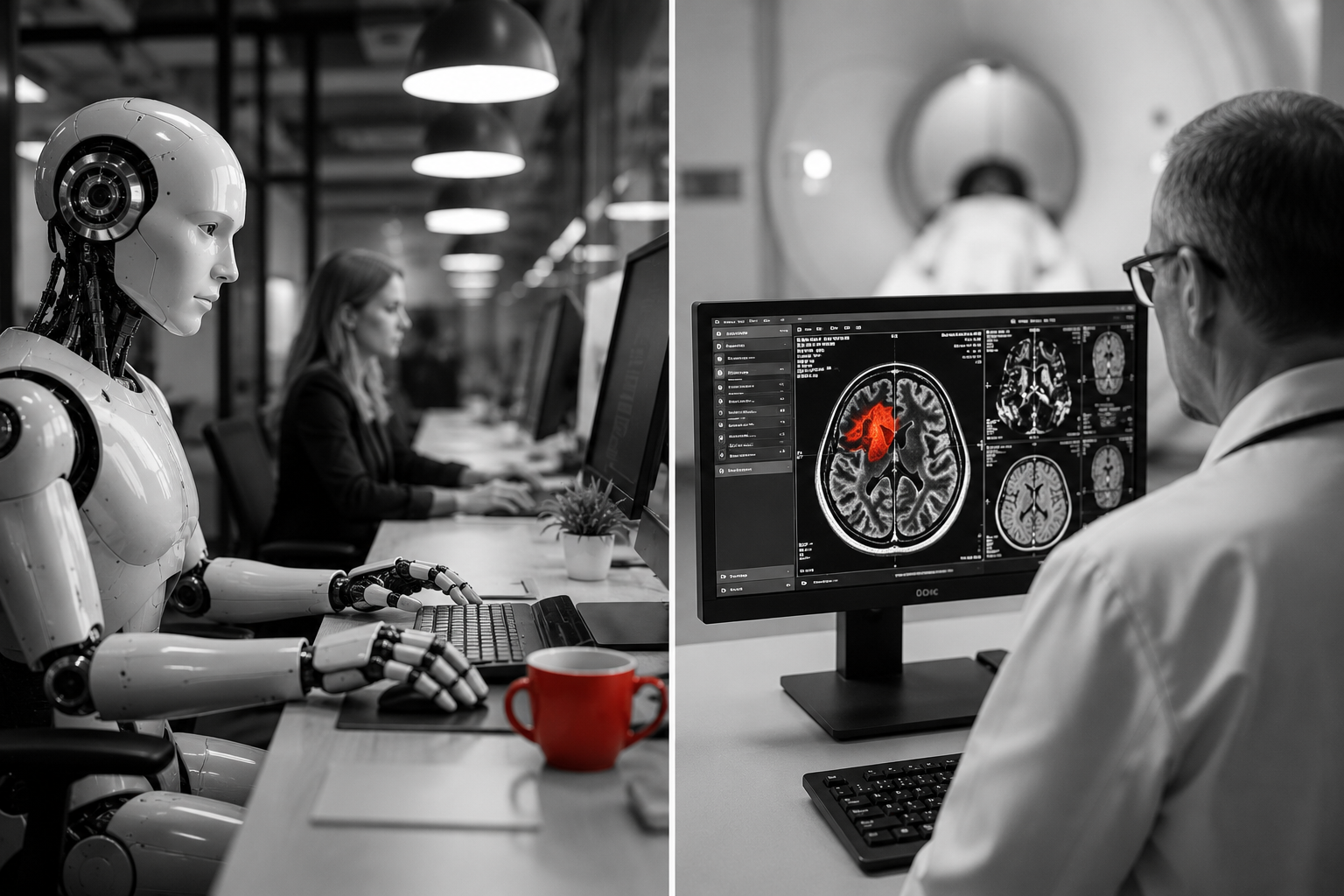
AI is undoubtedly replacing certain human tasks. Across factories, offices, banks, media organizations, and customer service centers, machines are performing work that previously required human effort. A chatbot can answer thousands of customer queries in seconds. An AI system can analyze millions of documents faster than an entire team of employees. Some companies now use AI to write reports, generate advertisements, create videos, and even produce news summaries.
For many workers, this transformation brings uncertainty. The fear of losing jobs to machines is not new. Similar concerns were raised during the Industrial Revolution when machines began replacing manual labor. Yet history teaches us that technological progress often eliminates some jobs while creating entirely new opportunities.
The difference today is speed.
Previous industrial revolutions unfolded over decades. AI is advancing at a pace never seen before. New tools emerge almost every month, and industries are struggling to keep up. Tasks that once required specialized skills can now be completed within minutes using AI-powered software.
The media industry provides a clear example. Journalists can use AI to summarize reports, transcribe interviews, translate languages, and analyze large datasets. However, AI cannot replace the human ability to investigate corruption, understand emotions, ask difficult questions, or make ethical judgments. Technology can assist journalism, but credibility, trust, and human insight remain irreplaceable.
The same principle applies to healthcare. AI can analyze medical scans with remarkable accuracy and help doctors identify diseases earlier than ever before. Yet patients still seek reassurance, empathy, and human understanding from medical professionals. Machines can process data, but they cannot genuinely understand human suffering.
Perhaps the greatest strength of AI is its ability to enhance human productivity. Businesses can automate repetitive tasks, allowing workers to focus on creativity, strategy, and innovation. Students can access personalized learning tools. Farmers can use AI-driven technologies to improve crop yields. Scientists can accelerate research that once took years to complete.
However, alongside these benefits come serious concerns.
One of the most pressing challenges is employment. Millions of routine jobs may disappear in the coming years as automation becomes more sophisticated. Governments and educational institutions must prepare workers for a rapidly changing economy by promoting digital skills, critical thinking, and lifelong learning.
Another concern is misinformation. AI can now generate highly realistic images, videos, and audio recordings that are difficult to distinguish from reality. While this technology offers creative possibilities, it also creates opportunities for manipulation, fraud, and the spread of false information. In an era where trust is already under pressure, responsible use of AI becomes more important than ever.
Privacy is another growing issue. AI systems thrive on data. The more information they collect, the more effective they become. This raises important questions about surveillance, data ownership, and individual freedoms. Societies must find a balance between innovation and protecting fundamental rights.
Looking ahead, AI is unlikely to replace humanity. Instead, it will redefine what it means to work, learn, and create. The future belongs neither to humans alone nor to machines alone. It belongs to those who can successfully combine human intelligence with artificial intelligence.
The workers most at risk are not necessarily those competing against AI, but those unwilling to adapt to it. Just as computers became essential in modern workplaces, understanding AI may soon become a basic requirement in nearly every profession.
The real challenge is not whether AI will become more powerful—it certainly will. The challenge is ensuring that this power is used responsibly, ethically, and for the benefit of society as a whole.
Artificial Intelligence has the potential to solve some of humanity's greatest problems, from disease and poverty to climate change and scientific discovery. Yet it also possesses the power to deepen inequality and disrupt lives if managed carelessly.
Technology itself is neither good nor bad. Its impact depends on how people choose to use it.
As humanity stands at the beginning of the AI age, one fact is clear: the future will not be written by machines alone. It will be written by humans who understand how to harness their power wisely.
The question is no longer whether AI will change the world. The question is whether we are prepared for the world it is creating.