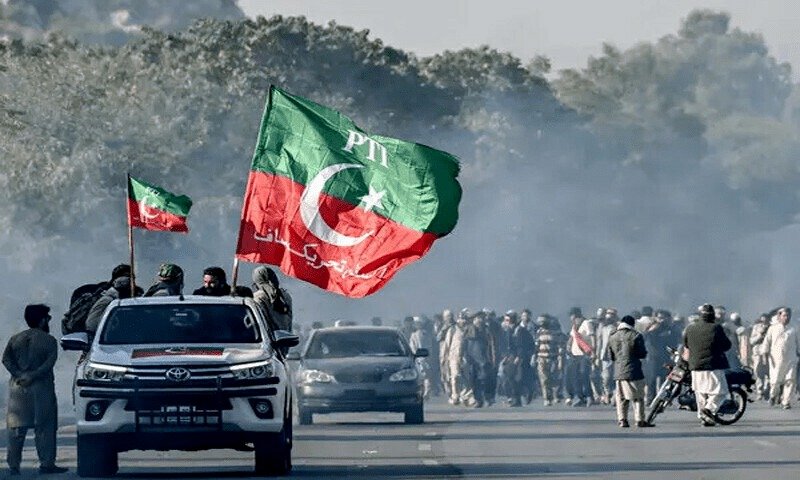
ISLAMABAD — Pakistan’s political confrontation is entering another legally sensitive phase after the Islamabad High Court (IHC) ruled that no political party or public office-holder has a lawful right to occupy roads, highways and other public spaces in a manner that obstructs access to essential services.
Syed Umar Gardazi/Islamabad
The ruling comes ahead of the Pakistan Tehreek-e-Insaf (PTI)’s planned September 27 protest and long march toward Islamabad, which the party has announced as part of its campaign for the release of its founder, former prime minister Imran Khan, and what it describes as a broader struggle for constitutional supremacy.
A three-member larger bench headed by IHC Chief Justice Sardar Muhammad Sarfraz Dogar, with Justice Muhammad Azam Khan and Justice Muhammad Asif, delivered the court’s order after hearing the petition filed by citizen Waqas Ahmed.
The petition had raised concerns that the planned mobilisation could disrupt traffic, business activity and the daily lives of residents in the federal capital.
Court rejects unrestricted right to occupy public roads
In its short order, the IHC stated that no political party or its leadership has a lawful right to occupy public roads, highways, interchanges, toll plazas or buildings in Islamabad in a way that obstructs access to educational institutions, medical facilities or other public services.
The ruling does not amount to a blanket declaration that political protests are unlawful.
Rather, the court has drawn a distinction between the constitutional right to political expression and the use of public spaces in a manner that prevents other citizens from exercising their own rights or accessing essential services.
That distinction is likely to become central to the political and legal debate surrounding the September 27 mobilisation.
Provincial governments told to stay out of political mobilisation
The court also directed the chief ministers of the provinces to ensure that government machinery and public funds are not used for political purposes.
The issue has been particularly significant because PTI's mobilisation has involved the political leadership of Khyber Pakhtunkhwa, where the party forms the provincial government.
The court had previously sought assurances from the Khyber Pakhtunkhwa chief secretary and inspector general of police that provincial resources would not be used for political gatherings. The officials were directed to submit affidavits confirming that government machinery and resources would not be used for such activities.
The broader question before the court was therefore not simply whether PTI could protest, but whether a provincial government could become directly involved in facilitating a political mobilisation directed toward the federal capital.
Chief Justice warns against unlawful assemblies
During the proceedings, Chief Justice Sarfraz Dogar addressed Khyber Pakhtunkhwa officials and indicated that unlawful or unconstitutional gatherings should be stopped.
The court's position places responsibility on the relevant authorities to maintain law and order while also respecting lawful political activity.
This creates a delicate balance.
The state cannot use public order as a justification to suppress every political demonstration. At the same time, a political party cannot invoke the right to protest as a legal justification for blocking roads, disrupting emergency access or taking over public infrastructure.
The court's order effectively places both responsibilities on the authorities and political actors.
PTI says protest is a constitutional right
PTI has maintained that its planned mobilisation is a legitimate political protest and has framed the September 27 march around demands including the release of Imran Khan and what the party describes as the restoration of constitutional and democratic rights.
The party has previously rejected attempts to portray its planned demonstration as inherently unlawful, arguing that peaceful political assembly is protected under the Constitution.
PTI leaders have also said that the protest is intended to mobilise supporters rather than undermine the constitutional order.
The legal challenge, however, focuses on the potential consequences of the mobilisation for Islamabad's residents, businesses, traffic and public institutions.
Why the case matters beyond PTI
The significance of the IHC ruling extends beyond the immediate dispute between PTI and the government.
Pakistan has repeatedly witnessed political demonstrations in which roads and highways have been blocked, containers deployed, businesses affected and public movement restricted.
The court's latest order therefore raises a broader constitutional question:
How can the right to protest be protected without allowing political mobilisation to deprive other citizens of their right to move freely, work, study, receive medical care and conduct ordinary business?
That question is particularly important in Islamabad because the capital contains Parliament, government ministries, diplomatic missions, hospitals, universities and other institutions whose operations can be affected by large political gatherings.
The state also faces scrutiny
The court's ruling should not be interpreted solely as a restriction on PTI.
The principle that public resources should not be used for political purposes applies to governments regardless of which political party is in power.
That means the same standard should apply to federal, provincial and local authorities.
If public vehicles, police resources, government employees, official funds or administrative machinery are deployed for partisan political activity, the issue becomes one of institutional neutrality rather than merely a dispute between political parties.
This is particularly important in a country where provincial and federal governments are frequently controlled by rival political parties.
A test for political maturity
The September 27 mobilisation could therefore become a test not only for PTI but also for Pakistan's broader political system.
For PTI, the challenge will be to demonstrate that a large-scale protest can be conducted without turning Islamabad's public infrastructure into a battleground.
For the government and law-enforcement agencies, the challenge will be equally difficult: enforcing the court's order without using it as a pretext for excessive restrictions on legitimate political expression.
The history of political protests in Pakistan suggests that the distinction between peaceful assembly and confrontation can disappear quickly when large crowds, blocked roads and heavy security deployments come together.
That makes restraint on all sides particularly important.
The economic cost of political blockades
The dispute also has a direct economic dimension.
Businesses, traders, transport operators and ordinary commuters can face substantial losses when major roads are blocked for prolonged periods.
A legal challenge against the PTI march specifically cited potential disruption to routine life, traffic and business activity in Islamabad.
Transporters have separately complained about the detention of trucks and containers allegedly being prepared for road-blocking arrangements ahead of the planned protest.
Such developments demonstrate why the court has focused not only on the political rights of protesters but also on the rights of people who are not participating in the demonstration.
The political stakes are rising
PTI has been intensifying preparations for the September 27 mobilisation, while the party has also sought political support from other opposition forces.
The planned protest has been presented by PTI as a major political confrontation with the federal government and as part of its continuing campaign over the imprisonment of Imran Khan.
The government, meanwhile, faces the task of maintaining public order while avoiding actions that could deepen the political crisis.
The IHC's intervention adds a judicial dimension to an already tense political dispute.
The larger constitutional question
At the heart of the case lies a principle that extends well beyond the current political confrontation:
A constitutional right is not necessarily an unlimited right.
The right to peaceful assembly exists alongside the rights of other citizens and the state's responsibility to maintain public order.
A political party can demand government change, challenge judicial decisions, campaign for the release of a leader and mobilise supporters.
But the exercise of those political rights must operate within the law.
At the same time, authorities must ensure that restrictions are lawful, proportionate and applied consistently.
That balance will determine whether the September 27 protest becomes another chapter in Pakistan's cycle of confrontation or an example of political mobilisation taking place within a functioning constitutional framework.
What happens next?
The immediate focus will be on how PTI responds to the court's order and how federal and provincial authorities implement it.
The September 27 date remains politically significant, but the IHC ruling has established clear boundaries concerning the occupation of public roads and the use of government resources.
The most consequential test may therefore not be whether PTI can bring supporters to Islamabad.
It will be whether Pakistan's political leadership, government institutions and law-enforcement authorities can manage a major opposition mobilisation without either paralysing the capital or suppressing legitimate political expression.
For a country that has spent years caught between political confrontation and institutional instability, that may ultimately be the more important question.