
Why Government Support — and Public Patience — Will Decide What Comes Next
Editorial | AALIMI NATION
Srinagar: Kashmir’s creative economy is showing its first real signs of momentum in a generation. Local designers are staging intimate fashion showcases in Srinagar built around the Valley’s most celebrated traditions — Pashmina, Kani, and Sozni craftsmanship. Indian and international film crews are returning to shoot in Kashmir at a scale unseen in decades, while a new generation of young Kashmiri filmmakers is beginning to tell its own stories instead of merely hosting other people’s productions.
This is not yet an industry. It is early-stage activity — scattered, under-funded, and largely self-organised. But it is real, and it raises a serious question that deserves public attention:
What would it take to transform this fragile creative momentum into a sustainable fashion and film economy, and what role should government and the public play in making that happen?
HOW THE WORLD SEES KASHMIR
Kashmir’s beauty has inspired travellers, artists, and writers for centuries. The famous words attributed to the Mughal emperor Jahangir still capture the emotional pull of the Valley:
“If there is a paradise on earth, it is this, it is this, it is this.”
Recently, an AALIMI NATION reporter spoke with Mr. Robert Powell, a visitor from the United Kingdom associated with independent film-location scouting and production networks in Europe. After spending several days in Srinagar, Gulmarg, and Pahalgam, he offered a striking assessment:
“I have travelled through some of the world’s most beautiful filming destinations, but Kashmir has an extraordinary combination of natural light, dramatic mountains, tranquil lakes, and living cultural heritage. For the film industry, it is a real paradise waiting to be properly discovered.”
He added:
“In Europe, a landscape like this would attract dozens of international productions every year. Kashmir already possesses what many countries spend billions trying to create artificially. What it needs now is wider publicity, better facilities, professional coordination, and confidence in its own potential.”
Whether one views these comments as tourism impressions or industry observations, they underline an important reality: Kashmir’s natural environment is not merely scenic — it is a significant economic asset for cinema, photography, and visual storytelling.
FASHION AND CINEMA ARE ECONOMIC INFRASTRUCTURE
In successful creative economies, fashion and film are not treated as decorative luxuries. They generate employment across multiple sectors: hospitality, transport, retail, textiles, design, catering, construction, and tourism.
Kashmir possesses three advantages that few regions can combine:
Globally recognised textile craftsmanship
Cinematic landscapes of exceptional visual value
A young, media-aware population eager for creative expression
What has been missing is not talent, but the institutional scaffolding — financing, training, infrastructure, and platforms capable of turning scattered creative efforts into a durable industry.
The legendary designer Giorgio Armani once observed:
“Elegance is not about being noticed; it is about being remembered.”
That insight applies remarkably well to Kashmir. The Valley’s strength lies not in spectacle, but in refinement, authenticity, and cultural memory.
WHAT GOVERNMENT SHOULD DO
1. Create a Single-Window Film and Fashion Facilitation Cell
Filmmakers currently navigate multiple departments for permissions, location access, logistics, and security clearances. Competing Indian states operate dedicated film facilitation offices that reduce delays and uncertainty. Kashmir requires a comparable mechanism if it wishes to attract sustained production activity.
2. Introduce Direct Production Incentives
Rebates on qualifying local expenditure are now standard practice in film-friendly economies worldwide. Such incentives have a multiplier effect on local hiring, hotels, transport operators, catering businesses, equipment suppliers, and craft producers.
3. Build Craft-to-Industry Training Pathways
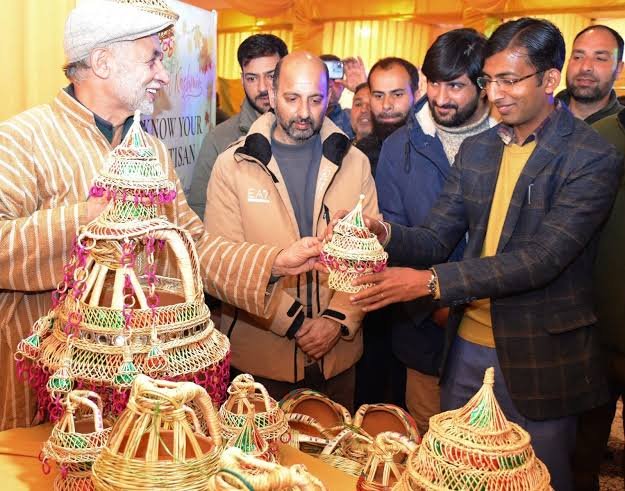
Kashmir’s artisans — Pashmina weavers, Sozni embroiderers, papier-mâché artists, and woodcarvers — represent a genuine competitive advantage. Structured training that connects master artisans with design institutes, pattern-making education, and modern garment-construction skills could transform traditional craftsmanship into globally marketable design capability.
4. Anchor Public Showcases in Heritage
Rather than importing a Mumbai- or Milan-style fashion-week format, Kashmir would benefit more from heritage-first textile showcases that families can attend together and that celebrate both the artisan and the finished design.
5. Establish a Dedicated Cultural Development Fund
Even modest but consistent annual funding for short films, documentaries, fashion incubation programmes, and young-designer grants would signal long-term institutional commitment and encourage creative professionals to build careers in Kashmir rather than relocate permanently to larger metropolitan centres.
THE HARDER QUESTION: PUBLIC READINESS
Policy alone will not determine success.
Kashmir is a tradition-conscious society that has spent decades associating cameras, public visibility, and media attention with uncertainty and risk. That social memory cannot be erased by administrative announcements.
Experience from other societies suggests that sequencing matters as much as policy:
Begin with heritage and craftsmanship, not spectacle.
Involve families, local communities, and cultural voices from the outset.
Allow local media to tell these stories with context and sensitivity.
Handled carelessly, a single controversial image can stall years of quiet progress. Handled thoughtfully, the creative sector can become something that the wider public recognises as authentically Kashmiri rather than externally imposed.
FOUR INTERNATIONAL LESSONS
South Korea: Culture as Infrastructure
After the 1997–98 Asian financial crisis, South Korea dramatically expanded public investment in culture, building institutions that later supported K-pop, K-drama, Korean fashion, and global cultural exports worth billions of dollars. The key lesson is sequencing: infrastructure was funded before the industry reached scale.
Bosnia and Herzegovina: Culture During Recovery
During the siege of Sarajevo, filmmakers created a makeshift cinema under extraordinarily difficult conditions. That initiative eventually evolved into the Sarajevo Film Festival, now one of Southeast Europe’s most respected cultural events. The lesson for Kashmir is that cultural rebuilding does not require waiting for perfect conditions; it requires care, persistence, and institutional continuity.
Iran: Global Cinema Within Conservative Values
Iran demonstrates that a faith-rooted and conservative society can still produce internationally celebrated cinema. Directors such as Asghar Farhadi, Abbas Kiarostami, and Jafar Panahi achieved global recognition not by abandoning cultural constraints, but by telling deeply local, human stories with honesty and artistic discipline.
Nigeria: Start Small, Grow Organically
Nollywood began as a low-budget, largely informal direct-to-video industry and has grown into one of the world’s largest film-production ecosystems. Its early years looked remarkably similar to what Kashmir is experiencing now: small-scale, locally driven, and largely self-funded activity.
THE FILM INDUSTRY’S VIEW OF KASHMIR
The celebrated filmmaker David Lean once said:
“The landscape is the first actor in a great film.”
By that standard, Kashmir already possesses an extraordinary cast: Dal Lake at dawn, the meadows of Gulmarg, the valleys of Pahalgam, the glaciers of Sonamarg, and the wooden architecture of old Srinagar.
Reflecting on this, Mr. Robert Powell remarked:
“Kashmir is not just visually beautiful; every location seems to carry a story. That is what separates a tourist destination from a world-class film location.”
THE AALIMI NATION POSITION
Our editorial view is straightforward.
Kashmir’s fashion and film sector will not grow through enthusiasm alone, and it will not grow through imported formats alone. It requires:
Government investment in creative industry as economic infrastructure
Professional film and fashion facilitation systems
Training that connects traditional artisans to modern markets
Patient, locally led public engagement rooted in heritage and dignity
The countries that succeeded in building globally respected creative industries did not do so by abandoning what made them distinctive. They built institutions strong enough to carry that distinctiveness to a wider audience.
Kashmir’s opportunity is not to become another Mumbai, Milan, or Seoul. Its opportunity is to allow its own Sozni, Kani, Pashmina, landscapes, and stories to reach the audience they have always deserved.
Mr. Robert Powell’s final observation may capture the essence of this moment:
“Kashmir does not need artificial film sets; it already has one of the most beautiful natural sets in the world. What it needs now is confidence, infrastructure, and the patience to let the world discover it properly.”
That is the challenge before policymakers, artists, entrepreneurs, and the public alike. If approached with vision, professionalism, and patience, Kashmir’s emerging fashion and film movement could become more than a cultural trend — it could become one of the Valley’s most important engines of employment, identity, and global engagement in the decades ahead.
— AALIMI NATION Editorial Desk