Internal objections, questions over voter-roll technology and the nationwide electoral revision have put India’s poll watchdog under renewed public scrutiny
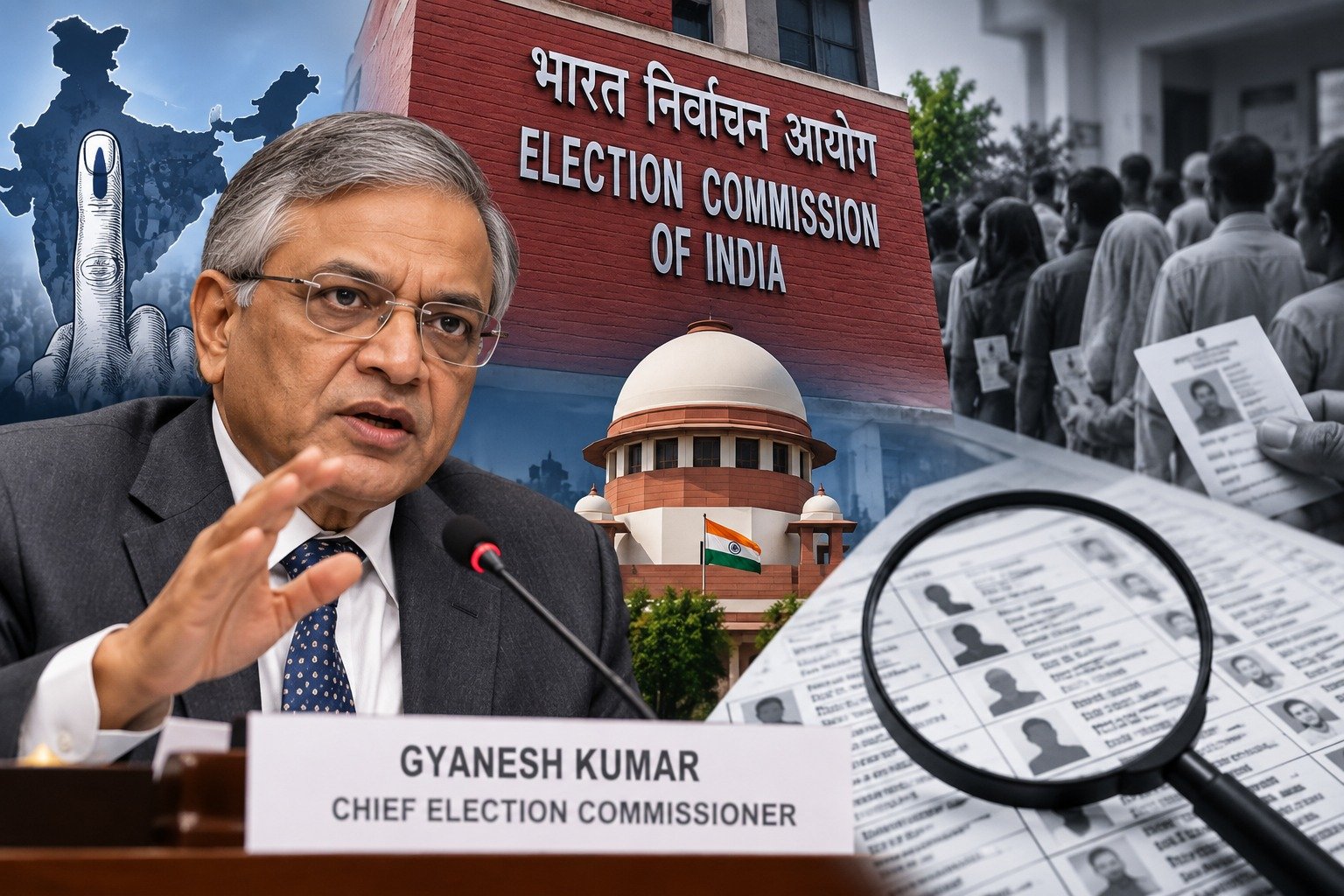
NEW DELHI: India’s Election Commission, the constitutional institution entrusted with conducting the country’s elections, is facing renewed scrutiny after an investigation by The Indian Express reported that two of the three Election Commissioners formally objected at least 14 times over a 10-month period to decisions concerning voter registration, electoral-roll management and the technology used to maintain voter data.
The allegations have triggered a fresh political and institutional controversy around Chief Election Commissioner Gyanesh Kumar, with opposition leaders demanding his resignation.
But the story is more complicated than a political confrontation between the ruling party and the Opposition.
At its heart lies a question that goes far beyond any individual election: who controls India’s electoral rolls, how are decisions about voters made, and how much internal disagreement can exist inside the constitutional body responsible for protecting the integrity of elections?
The controversy inside the Election Commission
According to the Indian Express investigation, Election Commissioners Sukhbir Singh Sandhu and Vivek Joshi raised formal objections on at least 14 occasions between November 2025 and August 2026.
Their concerns reportedly covered some of the most sensitive functions of the Election Commission, including the addition and deletion of voters, changes to voter-registration procedures, access to electoral databases and the security of the digital systems underpinning electoral rolls.
In one particularly significant development, the two Commissioners reportedly approached the Cabinet Secretary after raising concerns about changes in the allocation of responsibilities involving the Commission’s information-technology infrastructure.
The reported objections were copied to CEC Gyanesh Kumar.
The Indian Express described the episode as an unusual rupture inside an institution where collective decision-making is central to its constitutional role.
The Election Commission, however, rejected the suggestion that its functioning had broken down.
In its response to the investigation, the Commission said that differing views and observations were a normal part of institutional deliberation and that the decisions taken during the previous year—including those relating to the Special Intensive Revision—were ultimately unanimous decisions of the full Commission.
That distinction is important.
The existence of internal objections does not by itself establish that an election was manipulated or that any voter was unlawfully removed. What it does establish, based on the published investigation, is that serious questions were raised internally about the way certain electoral processes and technological systems were being administered.
Why the voter database matters
The controversy comes at a particularly sensitive moment because the Election Commission is conducting a nationwide Special Intensive Revision (SIR) of electoral rolls.
The exercise began in Bihar in 2025 and has subsequently expanded across much of India.
The stated objective is to identify and remove ineligible entries while ensuring that legitimate voters remain on the electoral rolls.
But the scale of the exercise has made it politically and administratively significant.
According to The Indian Express, more than 13 crore names had been removed from draft electoral rolls across 30 States and Union Territories by September 2026. The newspaper reported that the deletions represented approximately 14.1% of the pre-SIR rolls in the areas covered at that stage.
The figures need careful interpretation: removal from a draft roll is not necessarily permanent disenfranchisement. Electoral authorities provide mechanisms through which claims, objections, corrections and appeals can be made.
The Election Commission itself continues to provide online services for SIR-related claims and appeals through its voter-services portal.
The controversy therefore is not simply about the number of names removed. It is about whether the procedures used to determine who remains on the rolls are transparent, legally authorised and capable of correcting mistakes.
The Form 6 controversy
One of the most significant issues reported by The Indian Express concerns Form 6, the application used by new voters to register themselves.
The newspaper reported that a new question linking new-voter applications to the electoral roll from the previous intensive revision was introduced in the form.
According to the investigation, Commissioner Vivek Joshi had earlier raised concerns about changing the form without amending the relevant electoral rules, while Sukhbir Singh Sandhu subsequently described the change as “unauthorised and illegal”.
The issue goes to the heart of a basic democratic principle.
A person reaching voting age should have a clear and legally defined route to registration. If additional procedural requirements are introduced, citizens need to know why those requirements exist, what legal authority supports them and how applicants can challenge an adverse decision.
The Election Commission has not accepted the broader characterisation of its functioning contained in the investigation.
The technology question
Perhaps the most consequential part of the reported internal disagreement concerns ECINet, the Election Commission’s digital infrastructure.
Traditionally, electoral-roll preparation has involved decentralised statutory authorities at the constituency level, particularly Electoral Registration Officers.
According to the Indian Express investigation, both Sandhu and Joshi expressed concern that electoral-roll management was becoming increasingly centralised through the Commission’s IT systems.
Joshi reportedly warned about what he described as the “gradual centralisation” of the electoral-roll database and called for safeguards ensuring that unauthorised persons could not alter voter records.
Sandhu reportedly raised concerns about state-level officials not having complete access to the systems required for maintaining electoral rolls.
These questions matter because technology has become an increasingly important part of election administration.
Digital systems can make electoral management faster and more efficient. But they also create new questions about access, authorisation, audit trails, cybersecurity and accountability.
The more important electoral decisions become dependent on software, the more important it becomes to know who has access, who can change data, who can reverse a decision and who audits the system.
The Goa episode
The investigation also highlighted an episode in Goa involving 97 voters.
According to The Indian Express, Electoral Registration Officers had examined cases involving voters flagged for discrepancies and determined that 97 people were eligible to be included in the final electoral roll.
However, the newspaper reported that officials faced problems with the software mechanism required to reverse earlier deletions.
The case illustrates why digital systems in election administration cannot be treated simply as technical infrastructure.
If a statutory election officer has the legal authority to make a determination but the software does not allow that decision to be recorded, the question becomes larger than a computer problem.
It becomes a question of whether administrative authority is actually capable of being exercised through the system designed to implement it.
West Bengal adds another layer
The controversy also intersects with the intensely contested SIR process in West Bengal.
The Indian Express reported that the Commission told the Supreme Court that millions of appeals were pending before tribunals in cases involving voters affected by the revision.
The newspaper also reported questions raised internally about who authorised certain appeals concerning voters whose inclusion had been ordered by judicial officers.
Again, these reports do not by themselves establish wrongdoing.
But they demonstrate why the internal objections have attracted attention: they concern the procedures through which people are added to, removed from or restored to electoral rolls.
What does the law say?
The Election Commission is not legally structured as a one-person institution.
Under Section 18 of the Chief Election Commissioner and Other Election Commissioners (Appointment, Conditions of Service and Term of Office) Act, 2023, the Commission is expected, as far as possible, to transact its business unanimously. Where the members disagree, the matter is decided according to the majority view.
The same section says that the Commission may regulate its procedure and allocate its work by unanimous decision.
This provides an important legal backdrop to the present controversy.
Internal disagreement is not necessarily evidence of institutional failure. Indeed, disagreement can be part of collective decision-making.
The more consequential question is whether disagreements are properly considered, documented and resolved within the legal framework governing the Commission.
The Supreme Court’s position on SIR
The controversy should also be viewed against the Supreme Court’s May 2026 judgment concerning the Bihar SIR.
The Court upheld the Election Commission’s power to conduct the Special Intensive Revision, holding that the exercise was connected to the constitutional objective of maintaining free and fair elections.
The Court also directed that Aadhaar be accepted as an additional identity document for the Bihar SIR process, while clarifying that Aadhaar is not proof of citizenship.
That judgment is significant because it confirms that the Commission has constitutional and statutory authority to conduct intensive electoral-roll revisions.
But legal authority to conduct a revision does not eliminate the need for transparency in its implementation.
The larger question: trust
Elections depend on more than ballot boxes.
They depend on citizens believing that the electoral register is accurate, that eligible voters can register, that ineligible entries can be challenged through lawful procedures, and that mistakes can be corrected.
The Election Commission therefore occupies a particularly sensitive position in Indian democracy.
Its decisions affect not merely political parties but millions of individual citizens.
That is why the latest controversy has generated such intense interest.
The central question is not whether the Election Commission is allowed to revise electoral rolls. The Supreme Court has already recognised its authority to conduct the SIR.
The harder question is whether the process is sufficiently transparent and accountable to command confidence across the political spectrum.
A credibility test for India’s electoral system
The reported objections by two Election Commissioners have opened a rare window into the internal functioning of India’s election machinery.
The Election Commission says the decisions were ultimately unanimous and that differing views are part of normal deliberation.
The Indian Express investigation, meanwhile, has documented a series of internal objections concerning voter registration, electoral-roll access, software systems and administrative decisions.
Those two facts can coexist.
The task now is not to turn every disagreement inside the Commission into proof of electoral wrongdoing. Nor should serious institutional questions be dismissed merely because they have become politically controversial.
The appropriate response is greater transparency.
Where concerns have been raised about voter databases, the public deserves to know what safeguards exist.
Where questions have been raised about changes to voter-registration forms, the legal basis should be clear.
Where software has affected the implementation of decisions taken by electoral officers, there should be an auditable record.
And where Commissioners disagree, the institutional process for resolving that disagreement should be clear.
India’s democracy is too large—and the right to vote too important—for the administration of electoral rolls to operate as a black box.
The present controversy may eventually prove to be a dispute that is resolved within the Commission’s existing legal framework.
But it has already raised a question that deserves a clear public answer:
When the technology, procedures and officials responsible for deciding who appears on the electoral roll are themselves questioned from inside the Election Commission, who independently verifies that the system is working as it should?
That is the question now hanging over India’s election machinery.
Aalimi Nation News Desk
Reporting basis: The Indian Express investigation; Election Commission of India statements and voter-services material; Supreme Court of India judgment on the Bihar SIR. Additional context: BBC reporting on the controversy.